
Washington County Historic Directory Shelf
Washington County's historical directories are an uneven local shelf, not a complete annual series. The Stillwater Historical Society directory research route identifies the earliest located run as Pryor & Co. for 1876-77. It then traces printed and digitized volumes through directories held for Washington County through 2023. Stillwater Public Library, the Minnesota Digital Library, library-access databases, and Internet Archive copies each cover different years. Keep the exact volume year and its stated geography with every find.
| Directory collection | Years represented | Where held | How to use it |
|---|---|---|---|
| Pryor & Co. and early Stillwater volumes | 1876-77, then selected later years | Internet Archive and Stillwater Public Library | Read the scan or consult the local-history shelf; early entries may use intersections. |
| Minnesota Digital Library Stillwater volumes | 1882-83, 1887, 1890s and listed runs | Minnesota Digital Library | Browse digitized scans and retain the volume and page. |
| Library-access directory runs | 1900-07, 1910-15, 1917, 1919, 1924, 1927-31 | Stillwater Public Library access route | Check each volume's towns before treating a listing as a county match. |
| Stillwater and Washington County directories | 1937-99 selected runs; 2000-2023 county directories | Stillwater Public Library | Use the shelves and local collections; listed gaps remain meaningful. |
The Historical Society's directory year-run guide is the source for the collection image below. It makes the gaps visible, including no listed 1916 or 1918 volume, rather than implying a volume exists for every year.
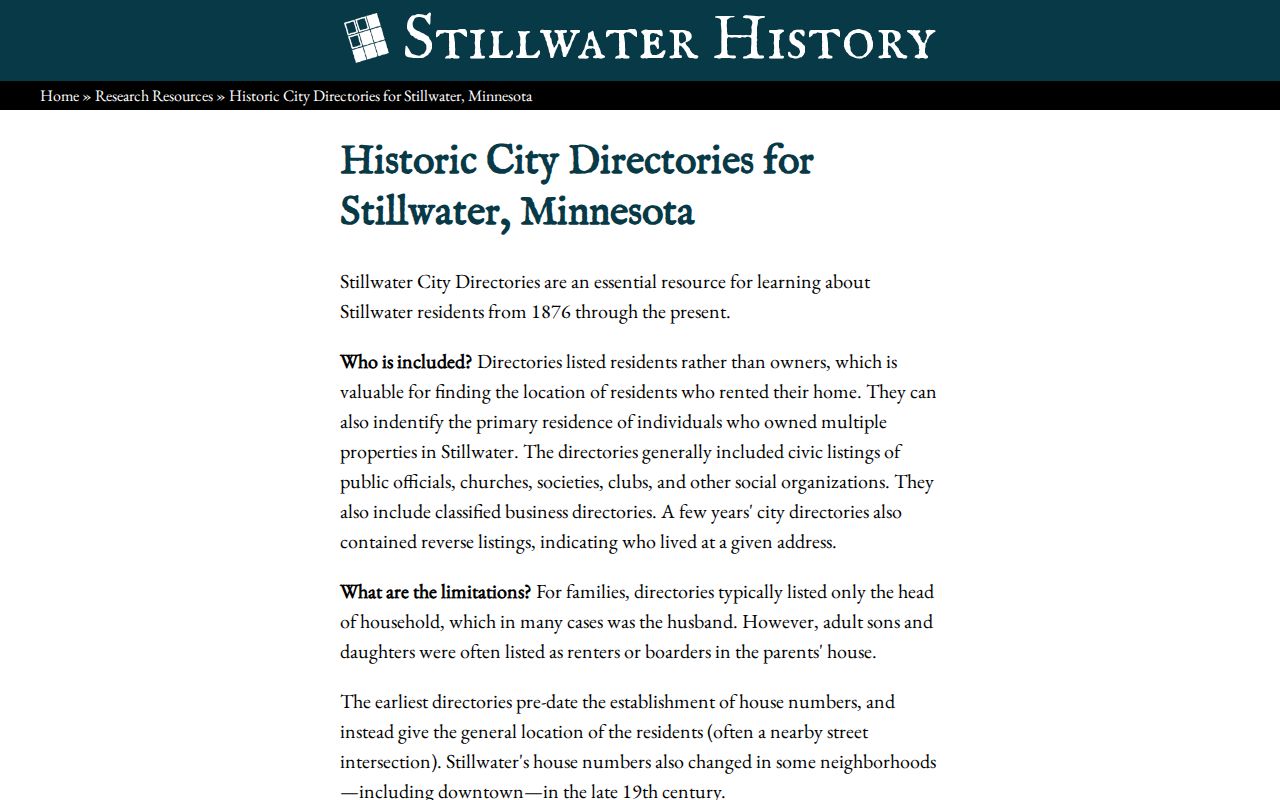
Those breaks can mark a missing publication, a different repository, or a change in the guide's coverage. Record a gap before drawing conclusions from a surname's absence.
Note: A historical directory lists a publisher's selected residents and businesses, so absence from one volume is not proof that a person left Washington County.
Stillwater Directory Runs Change Scope
The years tell only part of the story. The 1887 directory is documented as a Minnesota Digital Library scan with catalog identifier spl:2930. The 1898-99 source includes Hudson, Wisconsin, and the 1924 directory includes Stillwater and Bayport. A Washington County directory search should therefore begin with a volume's title page and introductory material, not an assumption based on a familiar place name. A postal city, a county line, and the directory's publisher territory can each point somewhere different.
Stillwater Public Library's holdings include 1881, 1884, 1908-09, 1937-38, 1942-45, selected 1948-68 volumes, 1970, 1972-89, and 1991-99. The named gaps are useful evidence. They may mean checking a newspaper, census, or an adjacent directory year rather than forcing a false year-by-year account.
- 1876-77: Pryor & Co. provides the earliest named Stillwater run located by the local guide.
- 1882-99: Digitized Minnesota Digital Library runs include 1882-83, 1887, and selected 1890s volumes.
- 1900-31: Library-access runs include selected early twentieth-century editions, with the 1924 volume covering Stillwater and Bayport.
- 2000-23: Stillwater Public Library lists annual Washington County directories, subject to the shelf's exact volume labels.
Washington County Directory Shelves and Scans
The St. Croix Collection at Stillwater Public Library is the local research-room route for directories alongside books, maps, photographs, clippings, and audio-visual material. Its Stillwater People resources also identify a limited obituary index, cemetery indexes, veterans material, yearbooks, parish microfilm, and local newspaper microfilm. The research room is at 224 3rd Street North in Stillwater, with collection assistance listed at 651-275-4338 and splinfo@stillwatermn.gov.
The Washington County Library genealogy resources add library-workstation access to Ancestry Library Edition, a FamilySearch affiliate-library route, historical newspapers, and classes. Those channels matter when a digitized volume yields an address but not the household context needed to test it.
The St. Croix Collection landing page is the source for this local-history image.
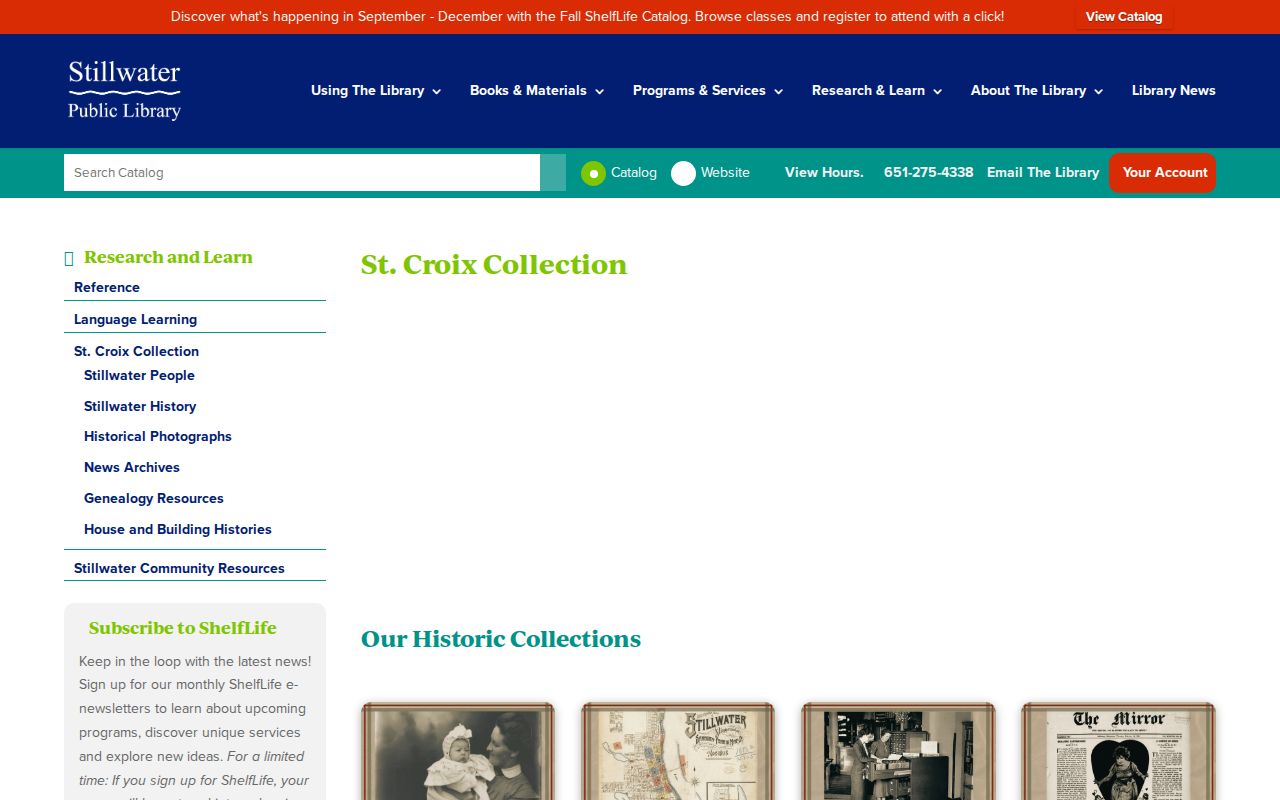
Use the collection's directories with its maps, yearbooks, obituary material, and microfilm. A scan is convenient, but the research room provides the stronger fallback when a needed run is not online.
How Washington County Directory Entries Read
A Washington County city directory entry usually begins with a name and may add a street address, occupation or business connection. Front matter and classified pages can add streets, wards, public officers, churches, schools, societies, and advertisements. Depending on the publisher and year, an entry may also include a spouse's name in parentheses, a widow notation, or another household clue. The 1887 inspection confirms name, address, occupation or business context, and page-scan access. It did not capture a reliable local abbreviation key, so read the actual volume's front matter before expanding any mark.
| Name line | The spelling or initials selected by the publisher. Search variants and middle initials when a surname is common. |
|---|---|
| Address line | The listed street or location for that edition. It can be an older number or an intersection in early volumes. |
| Occupation or business | Work or business affiliation when supplied. It helps separate people with the same name. |
| Household notation | A spouse, widow, or other household clue when the particular publisher printed one. |
| Context pages | Classified listings, civic pages, streets and advertisements that can clarify a name or address. |
- Criss-cross directory
- An address-first directory section, where present, arranged by street and number rather than by surname.
- Householder index
- A name arrangement centered on the named household contact, not a complete roster of everyone at an address.
- Abbreviation key
- The publisher's explanation of shortened terms, usually in introductory pages. Use the key from the same volume.
Directory presence is residence evidence for the edition date. It does not establish title to the property, every person in a household, or uninterrupted occupancy.
Directory Listings Do Not Prove Ownership
A directory speaks to a listed person at a stated address. A deed speaks to a recorded land transfer, and an assessor record ties current parcel data to a situs address, taxpayer or mailing address. Each source has a different job. When a historical volume produces an old address, use the entry as the lead, then use a legal description or recorded instrument when the question concerns the parcel itself. Modern address-keyed work belongs with the Washington County streets records.
That distinction prevents a common error in family history. A household head can appear in a directory while the property is held under another person's name, a trust, an estate, or a different legal description. Conversely, a recorded owner may not appear in the directory if the person lived elsewhere.
Washington County Directory Companion Indexes
The Washington County Historical Society research indexes extend the local name trail with source-specific material for directories, births, deaths, police registers, arrests, school graduates, newspapers, and coroner material. Underlying records may require an appointment or staff help, and coverage differs by source. Treat the index as a route to the record, rather than a replacement for the cited volume or original image.
The Historical Society's indexes and research-services page is the source for this Washington County historical-directory companion image.
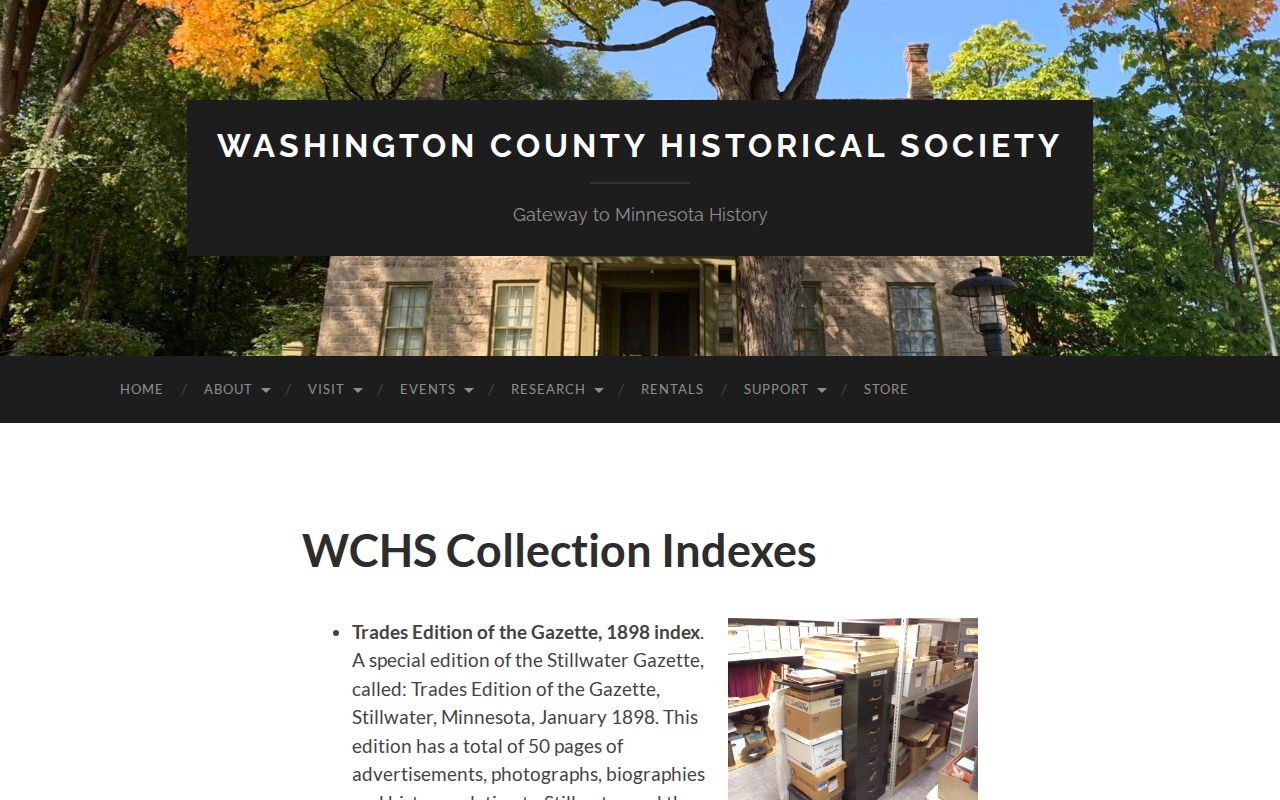
A directory address becomes more useful when a graduate list, obituary index, newspaper item, or cemetery clue supplies a second dated record. Keep the source name and coverage range with each note.
Washington County Directory Census Pairing
Pair a historical directory with a census schedule to turn a name-and-address clue into a household snapshot. Federal schedules are released under the 72-year rule, with 1790-1950 currently relevant. Minnesota territorial schedules include 1849, 1850, 1853, 1855, and 1857, followed by state schedules in 1865, 1875, 1885, 1895, and 1905. The 1905 state census can supply household and address details, but the cited guide says it has no name index.
- Find the first directory appearance and record the exact name form, address, occupation, page, and volume geography.
- Check the preceding and following listed volumes for a move, spelling change, or disappearance.
- Match the nearest released federal, state, or territorial census year and compare household members, age, birthplace, and occupation.
- Test an old number against a Sanborn sheet, a permit, plat, or deed legal description before treating it as the modern parcel.
- Use an obituary, probate item, or newspaper notice to investigate a later disappearance from the directory trail.
Names can change through marriage, initials, spelling, and publisher practice. The address and occupation are often the best way to distinguish two similarly named Washington County residents.
Washington County Directory Old Street Clues
Early Stillwater directories can use an intersection or a street number that no longer matches a current address. Local directory guidance warns that changing numbers can defeat a simple search. The county's address-system material also records different participation in the Uniform Street Naming and Numbering Agreement, including withdrawals by St. Paul Park in 2000, Mahtomedi in 2001, and May Township in 2002. That map does not list every renumbered house, but it gives a reason to verify jurisdiction and historical form.
For older Washington County directory research, bridge a doubtful address with a Sanborn map, street or ward list, historic permit, plat, or legal description. The Library of Congress Stillwater Sanborn set dates to May 1884, while local sources identify additional digitized maps through 1924 and microfilm through 1950. Maps show a footprint, use, material, stories, and street number, not an owner.
Note: Preserve the original directional, street type, and old number in research notes before replacing it with a modern postal form.
Washington County Directory Research Has Two Speeds
Digitized access is quick, especially for the 1887 scan and the Minnesota Digital Library runs, but the historical shelf is broader than any single online viewer. Stillwater Public Library holds local volumes and microfilm, Washington County Library provides research databases at library workstations, and the Historical Society supplies source-specific indexes and assistance. The right branch depends on the missing year, the address form, and whether a scanned page is legible.
Newspaper work has a similar split. Stillwater Gazette microfilm reaches from 1884 to 2016, while the active Stillwater Area Historic Newspapers effort reports more than 323,000 Washington County pages and continues Gazette digitization for 1947-77 during 2026. OCR can find a surname or street, but the page image remains the record to read and cite.
Tracing Washington County Directory Volumes
Use city directories as a repeated, dated household trail. Search the surname with spelling variants, initials, and occupation. Read each volume's geographic scope and abbreviation key. Then follow the same address through adjacent directory years, keeping the evidence separate from title records. A disappearance can reflect a move, death, changed name, publisher omission, or a missing directory year. Newspapers, death indexes, probate, and deeds help sort those possibilities.
Stillwater and Oak Park Heights carry the deepest local directory, newspaper, courthouse, and Sanborn trail. A rural township or newer subdivision may instead need a parcel, survey, permit, or county directory route. That change in records geography is why city directories are most useful when paired with the source that fits the address and era.